Monday, 2 March 2009

Hustings speech

We had the last of our hustings yesterday evening in Partick Burgh Hall in Glasgow and much as it has been hard work I've relished every moment of it. If you weren't able to catch us below is a copy of the speech I have been making up and down the country:

"I’m Dr Aileen McLeod. I’m here today because I want to be returned as an SNP MEP in this June’s Euro-elections.

For almost five years now I’ve worked in the EP as Head of Policy for Alyn Smith. In that time I have come to understand how the EP works, and, more importantly how we – SNP MEPs – can best make the EU work in the interests of the people of Scotland.

I want to be elected as an MEP because I want to put my experience and knowledge to work for the party and for the people of Scotland. European policy affects their lives. As an MEP my job is to ensure that EU rules and regulations reflect our national interests – the interests of the SNP Government and the interests of the people of Scotland.

Ultimately that can only fully be done by being an independent member of the EU and taking our place at Europe’s top table. In the coming campaign I want to take that message to the people of Scotland. For them to realise that the SNP is on their side in Europe.

And to tell them that Only the SNP can speak for Scotland because the SNP speaks only for Scotland.

The SNP has made a difference in Europe. Since May 2007 more and more MEPs have come to realise that Scotland is not one of Europe’s regions. They recognise that Scotland is a member state in waiting.

The SNP is rightly proud of the contribution its MEPs have made in the past. Dr Winnie Ewing, Dr Allan Macartney and Professor Neil MacCormick left a rich legacy of achievements. Ian and Alyn have built on these. And I want to take that legacy forward. I believe I can. I know how this European Parliament works. I know how to use the Parliament, and our position in it, to shape European Union policies.

EU policy is about more than the European Parliament. It is about tapping into the Commission and the delegations of member states that share our policy goals. It is about using networks of influence and building coalitions of support around our objectives. It is hard work. It is about defending our corner and pushing SNP policies. That is what I have been doing since I’ve been in Brussels. That is the work I now want to take forward as an MEP.

From my perspective Europe can be an opportunity for Scotland; but we have to work hard to maximise the opportunities.

Just look at the headline policies that the EU will legislate on in the near future:

  • Energy policy
  • Climate change policy
  • Reform of the Common Agricultural Policy (CAP) and the CFP
  • Re-regulation of the banking and financial services sector.

Each policy will affect Scotland in a significant way. Scotland’s voice has to be heard in the Brussels corridors of power, in the European Parliament.

We have to make sure that the EU legislation reflects Scotland’s interests where necessary. And we have to be ready to make our case. That is the attitude other countries take, and this is the job that I will relish as an MEP.

Scotland is well placed to gain from many EU policies.

We are Europe’s centre of renewable energy – we can export green technology as well as green energy; we have one of the EU’s largest financial services sectors – a sector that has been a victim of mismanagement by the London Government; we have a farming sector keen to be at the heart of discussions about the future of the CAP; and we have the world’s most ambitious Government when it comes to tackling the causes of global climate change as is now recognised by the EU.

Of course there are downsides – we only have to look at the disastrous Common Fisheries Policy – but as an independent Member State with a veto that would never happen again. Only as an independent country can we make sure that never happens again.

I want to see an Independent Scotland in the EU as a constructive member, but one that is not prepared to be pushed around.

As an MEP I want to listen to the Party at home and make sure that I represent all our interests in Brussels. I want to hear from our Branches, our CAs, our local councillors, our local MSPs and local MPs about their issues and concerns regarding EU policy and legislation. When I'm in Brussels I'm not dealing with foreign affairs issues, I'm dealing with domestic issues. I'm just dealing with them in a different place.

I want to make Europe work better in Scotland and that means that as MEPs we need to listen to our membership.

In conclusion, I have the experience, the expertise, the commitment, the passion and the know-how to make Europe work for Scotland, and to make an Independent Scotland work in Europe. What I need now is your support to let me get on with the job".

Saturday, 21 February 2009

Vote Aileen McLeod for SNP MEP candidate statement

Like our other European election candidates I have written a statement to all party members setting out why I want to be elected as an SNP MEP in this June’s European elections. My statement says:


It Matters
There’s turmoil in the world’s economy and Scotland is not immune, we’ll be bruised like any other country and we have to know why the European election matters. What Scotland does in Europe matters – cooperation across the EU will help Scotland recover when we have the chance. The European Parliament matters.


Making Europe work for Scotland
Scotland can be better and can have better international relations. Scotland needs MEPs who will make sure that Europe works for Scotland and that Europe works in Scotland. Alyn Smith and Ian Hudghton have been doing that and I hope to join them so we can do even more. With the performance of our Scottish Government, the high reputation of our MEPs, and the good, hard campaigning of our activists, we can win three seats.


From Dr Winnie Ewing through the tenures of Dr Allan Macartney and Professor Neil MacCormick to our two current MEPs we have done well in Europe. Our commitment to getting the best for Scotland is embedded in our work with our European partners.


Knowing how it works
The European institutions often seem complicated. The team we have in Brussels knows its way around and we’ve worked hard to bring European benefits to Scotland. We’ve brought Commissioners to Scotland and taken campaigners to Brussels – we work across the spectrum to deliver benefits for Scotland. We can make Europe work for Scotland.


The Future
We have to prepare Europe for Scotland’s Independence – we already have friends, but we must make sure Europe knows where Scotland is coming from and where we want Scotland to be going. We have to work with our European partners, and fight Scotland’s corner, taking Scotland’s cause forward and making Europe work for Scotland.


A Little About Me
Grew up in East Kilbride and now live in Lanark and Brussels.

MA Hons European Community Studies and German – (Edinburgh University 1993), Erasmus year – Germany; Robert Schuman Scholarship- European Parliament Office, London; EuroInfo Centre Ltd., Glasgow (1999 - 2001), Jean Monnet Centre of European Excellence – Glasgow University; PhD (2004) on UK media and European Parliament; Senior Research Specialist, Europe - Scottish Parliament research department (2001-04); Head of Policy for Alyn Smith MEP in Brussels and Edinburgh (2004-present) – advising and developing party policy on EU issues; Campaigned across Scotland.


What can we win?
I’m confident that our two sitting MEPs will be returned to Parliament, but we can win three with some hard work. I hope to be that third MEP, join our current Members and serve Scotland and the cause of Independence in Europe.


Vote Aileen McLeod.


European election candidate hustings

The hustings to rank the SNP’s candidates for the European elections this June got underway today with our first one in Eden Court theatre in Inverness this afternoon. Although this is the first time I have stood for election, it was great to be there and to get the chance to speak with members and answer their questions. We have an excellent array of candidates and I’m looking forward to the opportunity to meeting with as many of our members as possible up and down the country over the next couple of days.


Photo: Here's me outside Eden Court Theatre
after the hustings

The postal ballots have gone out and these are to be returned by midday on 10 March using the enclosed pre-paid envelope to the Electoral Reform Society. If you would like to hear and meet the candidates we will be at the following locations:

21 February: The MacLean Room, Eden Court Theatre, Inverness 13h00

22 February: Function Room, Huntly Arms Hotel, Aboyne 12h00

22 February: Green Hotel, Kinross 17h00

28 February: County Hall, County Buildings, Ayr, 11h00

28 February: Town Hall, Johnstone 16h00

28 February: Cornerstone House, South Road, Cumbernauld 19h00

1 March: Arts Centre, Dalkeith 14h00

1 March: Partick Burgh Hall, Glasgow 18h00

Monday, 16 February 2009

New front opens on Scotland's offshore wind

Alex Salmond opened the doors today to Seaenergy renewables based in Aberdeen following the announcement today by the Crown Estate that SeaEnergy has been given the green light to explore and develop the Beatrice offshore wind farm site in the Moray Firth and the Inch Cape for offshore wind. If operating at maximum capacity, these sites would have the potential to generate a massive 6GW of offshore windpower. This equates to Scotland's peak electricity consumption.

The Crown Estate announced a number of other exclusive agreements for companies to survey areas of the seabed to develop offshore wind and other types of marine renewables. The shores around the Highlands and Islands are laden with enormous green energy potential just waiting to be tapped into. The oil fabrication yard at Nigg could become a hub for the engineering and construction of renewable energy developments (deep water offshore wind turbines, tidal and wave turbines), putting it right at the cutting edge of such developments and making it not only good for the local economy but for Scotland as a whole also. The Scottish Government has already revealed that there could be 16,000 Scottish jobs in green energy by 2020 by progressing its action across energy generation, energy efficiency and transport, tackling climate change and at the same time saving people and businesses alike money.

I am delighted at the news today. With Jim Murphy in Edinburgh selling his soul to the nuclear lobbyists in his grand plan to convince Scots of their need for a nuclear future, today's announcement underlines the extent to which Scotland's energy companies are leading the way in the development of clean, green energy and the boost this will bring to Scotland's economy by way of increased investment, more jobs and opportunities.

I had the chance to spend some time with SeaEnergy last August when I was up at their offices in the outskirts of Aberdeen to meet with the team and find out what the company was seeking to do in terms of helping Scotland to take full advantage of the massive offshore wind potential that is sitting out in the Moray Firth in particular.

I've already put in a call to congratulate them and look forward to having the chance to meet with them soon to discuss their plans.

Friday, 9 January 2009

NO TO LISBON

If you have ever wondered what UKIP do in the EP then the photos from my office might explain:


Saturday, 3 January 2009

Happy New Year!

I'm up in Port Appin, Argyll for the weekend with some friends of ours before heading back to Brussels next week and if you've never been to Port Appin, it is worth a visit. We were up here last New Year for a week and this time we are up to see our friends get married on the shores of Loch Linnhe. For me its a great place to gather my thoughts before the onslaught of Brussels begins again, not least with the European election campaign ahead of us.

We were staying in the Pierhouse hotel - a great place if you love seafood. The scenery up here is stunning with Castle Stalker sitting out there on Loch Linnhe and the Morvern mountains behind. Today we went across to the island of Lismore and had a walk round the island. There is a great community spirit there and if you fancy a trip across there you could try and time it so that you are there for Lismore's own Homecoming celebrations which it is planning to mark from 8 - 14 August, and apparently there is the chance to enjoy a glass of Lismore malt whisky at its opening reception.


Photo above: Looking across to the Morvern mountains


Photo above: Port Appin


Photo above: With the "Lismore" boat across to the island of Lismore

Photo above: The island of Lismore

Photo above: Looking across from Lismore to Morvern


Photo above: Still on Lismore with Port Appin behind me


Photo above: Winter sky from the beach at Lismore

Friday, 19 December 2008

Montenegro applies to join the EU

Montenegro's Prime Minister, Milo Djukanovi, was in Paris this week to submit an application from Montenegro to join the EU. The Prime Minister met with the President-in-Office of the European Council, Nicolas Sarkozy, to whom Montenegro's EU application was submitted. This will be sent to the European Commission which will then assess whether Montenegro meets the conditions of membership and make its recommendation to the Council as to whether or not Montenegro should become a candidate country. It is then for the European Council to vote unanimously on the Commission's recommendation and in doing so open formal negotiations.

Having achieved its independence on 3 June 2006 and now two and a half years later has lodged an application to join the EU. I wish Montenegro well in its application and look forward to the day when an Independent Scotland joins Montenegro at the top table not only in Brussels but also in the UN in New York and in other international organisations and is able to have its own distinctive voice, take its own decisions and work together with the international community in addressing such key global challenges as international development, climate change, economic governance.

I've met with the Montenegrin Ambassador to the EU on a number of occasions in Brussels to find out how Montenegro is faring since achieving its independence and have also helped Montenegro mark its national day on 13 July by holding out a hand of friendship from Scotland
.

Wednesday, 17 December 2008

EU's major boost for Scotland's climate change effort

The European Parliament finally adopted the EU climate change package today - I watched the vote from the office in Brussels. There was a sense of achievement when the climate change package went through and from the Parliament's side all those who worked on the details of the deal should be commended for the effort that went in. Out of all the legislation, MEPs passed today the most crucial one for Scotland was the adoption of the renewables package. With the setting of a 20% renewables target by 2020 the boost this will bring to Scotland's renewables industry will be massive. It will see increased EU funding and research resources for energy infrastructure projects, including the North Sea supergrid, cut red tape for renewables and ensure there is priority access for connecting renewables to the grid.

The carbon capture and storage package is also key for Scotland not least because of the support it will provide to the CCS industry in Scotland in terms of giving the industry legal certainty for investments. Once again, the EU's support for carbon capture and storage in Scotland is well recognised which is in complete contrast to the attitude in London which pulled the plug on Scotland's opportunity to lead on CCS technology through the Peterhead power station project. Scottish Power's Longannet coal fired power plant is currently bidding to win the UK's CCS pilot competition- I hope this time round all parties will back Scotland's bid to lead in this area.

Friday, 12 December 2008

Tougher EU action on climate change?

So EU leaders finally reached a deal on climate change. I did wonder if the EU leaders would manage it with Italy and Poland having earlier in the negotiations threatened to veto the package but the stakes were too high if the EU had failed - what signal would this have sent out to the US, China, India and the developing countries if the EU hadn't been able to reach a deal. For one thing it would have certainly weakened the EU's hand and its position in leading the world in the run-up to the negotiations for a new international climate change agreement in Copenhagen next December.

While the 20/20/20 targets by 2020 remain intact and while there are significant improvements, the compromise deal has been seriously weakened with the winners heavy industry (supported by Germany, Poland and others) in that some industrial sectors will be exempt from the full auctioning of emissions permits and able to receive up to 100% of allowances free from 2013 until a new international agreement on climate change is concluded. A review is scheduled in 2018. This applies to those industries most at risk from "carbon leakage" concerns - i.e. that manufacturing industry could pull out of the EU and relocate to countries where their polluting laws are less stringent. Sectors exposed to carbon leakage are to be identified by the Commission by the end of December 2009.

Free allowances will be allocated on the basis of best-in-class technology benchmarks. The Commission has estimated that more than 90% of manufacturing emissions would qualify.

The number of emission allowances will be capped in order to deliver a 21% cut in industrial emissions during the whole period 2013 to 2020 compared with 2005. During the trading period EU allowances will increasingly have to be auctioned rather than being distributed free-of-charge.

The power sector will have to buy 100% of allowances from 2013. But Poland and some other eastern states managed to win concessions enabling some of their power stations to receive up to 70% of allowances free in 2013, declining to zero in 2020. Eligible plants will be those poorly integrated into the European electricity grid or those that individually provide more than 30% of national electricity in countries with relatively low GDP.

For those industries not at risk of carbon leakage, the auctioning rate to be reached in 2020 is set at 70% with a view to reaching 100% in 2027, bearing in mind that the initial level in 2013 is set at 20%. Germany and Italy were calling for 80% of free quotas right the way through. A deadline for the introduction of 100% of paid quotas has been set as 2025, five years later than what the Commission had originally proposed.

There is to be a financial solidarity mechanism. 88% of the total allowances to be auctioned each year will be distributed among the 27 EU Member States with the revenue from the remaining 10% of carbon allowances auctioned by EU Member States being allocated to many of the central and east European countries to help them modernise their energy infrastructure. An additional 2% would be distributed among those that had reduced their greenhouse gas emissions by 20% in 2005 relative to 1990 levels.

Between 2013 and 2016, Member States will be authorised to use money raised at auction to provide up to 15% of the investment costs of building high performance electric power stations.

Pre-allocation of part of auctioning revenues: The European Council notes the will of Member States to devote at least half of all auctioning revenues to finance climate mitigation and adaptation efforts in Europe and the developing world, but without a binding commitment. So there is only a voluntary earmarking of 50% auction revenues for climate purpose with it left very much up to the Member States to decide.

A greater number of smaller industrial installations will be excluded from the EU ETS under the compromise text where the threshold for exclusion has been raised from 10,000 tonnes CO2 emissions per year to 25,000.

The Commission must propose including shipping in the scheme from 2013 if there is no international climate agreement by the end of 2011.

Allowances will be allocated centrally by the European Commission, rather than by Member States through national allocation plans.

When it comes to funding for carbon capture and storage EU leaders agreed that up to 300 million allowances in a new entrants reserve (the European Parliament was calling for 350 million) can be used to fund CCS measures until the end of 2015. Plants fitted with CCS will be regarded as not emitting any greenhouse gases.

We are all now looking to the European Parliament to keep the pressure on for ensuring there is tough EU climate change action and that the 20/20/20 deal stays on course during next week's crucial vote. Scotland of course is already leading Europe and the rest of the world with the publication last week of the Scottish Government's ambitious climate change bill.

Thursday, 11 December 2008

Ireland made to vote again

EU leaders are in town today for the end of term European Council meeting - the constant hovering of helicopters outside the office window and blaring of police sirens is always a sure tell tale sign of their arrival and movement across Brussels.

On the agenda is some hefty dossiers - the climate change package which we need to see a deal reached on and the EU's response to the economic crisis with its economic recovery plan. But before that there is the issue of Ireland's rejection of the Lisbon Treaty in a referendum last June to sort out. I genuinely feel for Ireland - being made to find a way out of the impasse when its people have already said, in a democratic vote, to the government, no we don't fancy this Treaty.

I'm not going to say much on this as we already know that Ireland has been given a number of legal guarantees on those issues of concern expressed by the Irish, i.e. neutrality, tax policy, social, ethical and family issues. There was also agreement about each Member State being able to keep its own Commissioner in future European Commissions. These are to be written into a protocol together with Croatia's accession treaty to the EU in 2010 or 2011.With these guarantees Ireland can now proceed to asking its people again to vote in another referendum on the Lisbon Treaty before November 2009. This is no way to do business in the EU and is frankly disappointing.

Tuesday, 9 December 2008

EU renewables boost for Scotland

The EP and Council are still in the midst of negotiating the EU's climate change deal and from what we are hearing and seeing the negotiations are proving to be ever more difficult with the financial crisis being seemingly used by many member states to 'backtrack' on commitments they made previously. The deal comprises a number of legislative proposals including the revised Emissions Trading Scheme, sharing effort in reducing greenhouse gases with developing countries and carbon capture but for the moment concerns remain over the issue of carbon leakage (i.e. where there is some concern that polluting industries could relocate to other countries that have less stringent emissions regulations), the redistribution of revenues of auctions, solidarity and funding of carbon capture and storage pilot projects.

However, the EP did manage to get a compromise on the renewables package, which contains a number of key points crucial for Scotland and our renewable industry:

Mandatory renewable energy targets: the 20% binding target for EU energy consumption to be produced by 2020 has been retained and there is to be interim targets fixed for each Member State but these will be non-binding. The EP did manage to strengthen the requirements around the National Renewable Energy Action Plans that each Member State has to submit to the Commission by 30 June 2010. Member States are obliged to submit an amended action plan if they miss the interim or 2020 targets. The Commission can also initiate infringement proceedings if a Member State fails to introduce "appropriate measures" to meet its interim targets or if its national action plan is judged to be inadequate. This is supposed to ensure Member States do actually deliver their targets on time. Measures for improving energy efficiency are to be included in the action plans. Progress reports are to be submitted to the Commission every two years detailing their shares of renewable energy, support schemes and progress on tackling administrative and grid barriers.

Flexibility and cooperation mechanisms whereby Member States work together under such mechanisms enabling them to help each other meet their national targets. Such cooperation could entail the statistical transfer of renewable energy between countries or taking part in joint renewables projects. National support schemes for renewables can also be joined up between various Member States to help achieve targets. The European Parliament managed to strengthen transparency requirements for "green electricity" with an online transparency platform for Member States to access and exchange information on the new renewables directive. EU countries can also meet their targets by importing electricity from non-EU countries under certain conditions, i.e. that the electricity must be consumed in the EU.


When it comes to the use of renewables in buildings Member States will have to introduce measures to increase the uptake of renewables in the building sector.

The Parliament was also successful in cutting the red tape and reducing the administrative burdens for investment in renewables and in ensuring legal guarantees for priority access of renewables to the electricity and gas grid with the importance of developing central district heating and cooling systems using renewables highlighted.
Not all of the deal is good - on biofuels the position retains the 10% target for renewable fuels in road transport by 2020. Although disappointed, it has at least been watered down and made more flexible. One third of the target will be made up through electric cars and trains, not biofuels, and the target will be reviewed in 2014. The Commission will bring forward proposals in 2010 to limit indirect land-use change, and biofuels from non-food sources will be promoted with a "double bonus" scheme.

On the whole I think this compromise is probably as good a compromise as we are going to get and we now await to see the outcome of the ongoing wrangling with the other climate change dossiers. With the mini session last week in Parliament, MEPs had the opportunity to hear from the EU Energy and Environment Commissioners and the French EU Presidency about the state of play with the rest of the negotiations. EU Energy ministers met yesterday in Brussels and the EP is supposed to vote on the whole package on 17 December, so we can only hope a deal is reached at the European Council in Brussels next week.

If the EU is to be taken as a serious global player in the UN climate change negotiations in Copenhagen next December then it needs as strong and united a position as possible.

Monday, 8 December 2008

Opening of Fionna Carlisle’s energy exhibition

Scotland’s Minister for Europe and Culture, Linda Fabiani MSP formally launched Fionna Carlisle’s North Sea oil portraits exhibition this evening at a reception hosted by Alyn, the Scottish Government EU Office, the Scottish National Portrait Gallery and Highland Council.

I had gone down to the exhibition earlier in the day to see what the portraits looked like hanging up as a collection. With EU energy ministers having met on Friday and EU environment ministers meeting today to continue negotiations on the EU climate change package and EU leaders meeting at the end of the week the timing of the exhibition could not have been better. Combining Scotland’s unique culture with our energy industry worked extremely well and being able to help showcase a Scottish artist right at the heart of Europe was certainly well worth doing, exposing EU officials from 27 Member States, Ambassadors and other visitors to the EP to the significance of Scotland's oil and gas industry.

Of course the recent publication of the McCrone report (1975) under the 30 year rule showed the lengths successive UK governments went to to deprive Scotland of access to our own North Sea resources and Scotland's independence. According to the McCrone report, an Independent Scotland with her oil and gas reserves would move from being Europe's 10th wealthiest nation to Europe's third wealthiest nation.

It is scandalous as it is outrageous to think what the people of Scotland have been denied after 30 years of lies and deceit by successive UK governments. For a copy of the McCrone report and the truth about Scotland's oil rich economy have a look at the following website: www.oilforscotland.org


Above: With Linda Fabiani MSP and the First Minister


Above: With the artist, Fionna Carlisle

Sunday, 7 December 2008

Scottish Trad Awards, Glasgow’s Old Fruitmarket

Having got back from Brussels late on Friday night it was straight to Perth yesterday morning for National Council. A number of motions were passed not least on trade justice and on the ongoing and worsening humanitarian crisis in Palestine, especially Gaza. I’m pleased to say that MEPs earlier this week had voted to postpone voting on the EU-Israel Association Agreement (essentially the Memorandum of Understanding on Israel’s increased involvement in EU funding programmes) given the escalation of the crisis. Our Group in the Parliament had requested it be removed from the agenda for the time being along with the Socialists and the Group of the United European Left.


At the end of National Council I took part in the European hustings with our other candidates for the EP elections next June chaired by Angus Robertson MP. With the party’s hustings not til February this was a good opportunity for members to see who we all are and to hear from each of us.


Thereafter it was straight down the road to Glasgow with Rob Gibson MSP to the 6th Scottish Traditional music awards taking place that evening in Glasgow’s Old Fruitmarket for the first time. Once again it was a fabulous night – this was my third Trad awards with the last two years held in Fort William’s Nevis Centre. Tonight was being televised by MG Alba for the first time. Rob had booked a table for us all.


It was great to see and hear so much of Scotland’s own talent and to be part of this cultural experience. The music was as ever just stunning. Tonight was opened by Capercaillie with performances from Lau, Karine Polwart, Session A9, Breabach and Jeana Leslie and Siobhan Miller. The Trad Awards was where I first heard our Gaelic Ambassador, Julie Fowlis, and it certainly opened my mind to learning more about my own cultural heritage which is played out in so many of the Gaelic songs which are just simply beautiful.


Already I am looking forward to 7th annual awards in Dumfries in November 2009 which will also conclude the Scottish Homecoming celebrations in 2009.


Above: With Linda Fabiani at the Trad Awards after a fantastic evening of music.

Friday, 5 December 2008

Scotland’s North Sea energy portraits in Brussels

I was in early this morning to meet Will Mulholland of Art Link who was delivering a collection of 25 paintings by the distinguished Scottish artist, Fionna Carlise to the European Parliament. This was her Energy: North Sea oil portraits exhibition which has previously been shown in The Scottish National Portrait Gallery in Edinburgh, Duff House, Shetland Museum, La Defense in Paris and now for the first time in Brussels and the first time in the European Parliament.


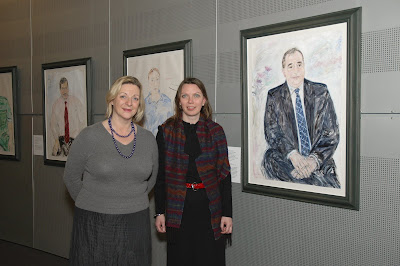
The collection focuses on the vital role played by Scotland’s oil industry with portraits of various individuals who have played their part in the history of our oil industry, from oil-rig builders, helicopter pilots to the technical and service staff on the rigs themselves. It also includes a painting of Alex Salmond before he became First Minister of Scotland.


Alyn was sponsoring the exhibition which opens in the EP on Monday for a week. We had booked the Yehudi Menuhin space last December so it has taken us a year to be able to bring such a collection to Brussels – such is the pressure on space in the EP and believe me it is no easy feat. With 27 Member States plus all their different regions wanting to showcase their cultural heritage in the EP (and what a great place to do it in), you need to book key space at least a year in advance.

The exhibition had been organised as a real collaborative effort with the Scottish National Portrait Gallery, Highland Council and the Scottish Government EU Office.

The works on display are a striking and dramatic interpretation of Scotland's energy resources and provide an interesting cultural landscape to the current debate on the EU's proposed Energy Package.

More information about the artist and her work can be found on her website at
www.fionnacarlisle.com

As the office of the MEP sponsoring the exhibition I had to be there in the EP’s garage to meet them and ensure there were no problems with security. Standing at 8.30 in the morning in the freezing cold in a place the size of an airport hangar and where I’d never been before I had a real sense of anticipation as I waited for a collection of Scottish art to arrive from home. After weeks of preparation it was finally here.

I had first met Fionna Carlisle, who comes from Wick, in June when she came across to Brussels with Julie Lawson of the Scottish National Portrait Gallery to see for herself the space we had booked for her collection. One of the things that is great about this collection is that Fionna actually went offshore and spent some time on the oil platforms to enable her to get a better understanding of Scotland's oil and gas industry - but it is a fantastic collection.


Ironically, this exhibition has arrived in Brussels just as the Scottish Government published its climate change bill which if passed will ensure Scotland has the most ambitious climate change legislation anywhere in the world with all six Greenhouse gases and emissions from international aviation and shipping included within the ambitious 80% target by 2050. This should put Scotland at the forefront of global and European efforts to tackle climate change.


Here are some of the paintings from the collections on display inthe European Parliament this week:


Tuesday, 2 December 2008

Labour's carping on marine renewables

Glad to read this morning the supportive comments from the EU's energy commissioner, Andris Piebalgs about the Scottish Government's 'strong leadership' in developing the Saltire Prize. The EU's recognition of the Scottish Government's commitment to advancing marine renewable technology (wave and tidal power) by launching a world-wide competition with its £10 million Saltire Prize shows how far Scotland's relations with Europe have come since the SNP took power in Scotland last May. It also stands in complete contrast to the bizarre and negative carping from the Scottish Labour leader, Iain Gray (as reported in today's Herald, "Salmond urged to do more on energy front").

This Scottish Government has done far more on the renewable energy front than Labour ever did in its 8 years of power where nothing was done to encourage or incentivise the massive potential sitting on Scotland's doorstep, around its shores.
Scotland has massive marine renewable potential with the Pentland Firth very much the Saudia Arabia of marine power. With 25% of Europe's tidal power and 10% of wave power, the potential for further investment, jobs and opportunities not to mention for Scotland as a whole in leading the world in developing renewables in this area is enormous. Scotland has waited a long time for this potential to be finally realised.

Saturday, 29 November 2008

SNP quiz night in Forth

I was up in Forth last night at the Royal British Legion Club for a quiz night organised by my own local branch, the Wallace Branch, and assisted by Carluke. I met up with Aileen Campbell MSP and other members of the Clydesdale CA and although my team didn't win, we still managed to raise £240 for election funds. It was a good night so a big thanks to all those who helped organise it.

Wednesday, 26 November 2008

The EU's economic stimulus package - will it work?

With the worsening economic and financial crisis the EU finally published its response today with its European economic recovery plan. I've not yet had the chance to go through all the details of what the Commission is proposing but its clear that this is not a one size fits all- it couldn't possibly be given the differences between Member States in terms of their budgetary and economic situations and outlook and their exposure to the current economic and financial crisis.

Top line is the fiscal stimulus of 200 billion euro (1.5% EU GDP). Most of the money will come from national budgets, with EU Member States asked to contribute 170 billion euro (1.2% of EU's GDP). The rest -around 30 billion euro or 0.3% of EU GDP would come from the EU's own budget and the European Investment Bank.


The recovery plan is based on short-term measures to boost demand, protect jobs and restore consumer and business confidence. It aims to drive a coordinated EU response to the economic crisis and builds on the coordinated EU response to the financial crisis.

The Recovery Plan combines coordinated national action with a number of EU policy measures that have already been adopted by some national governments. There are 10 priority initiative measures:
(1) increased support for the unemployed and the poorest households, which have been hit hardest by the economic slowdown, by launching an employment support initiative through the European Social Fund and the Globalisation Adjustment Fund, increasing efforts to develop skills.
(2) Creating demand for labour by adopting temporary VAT cuts across the whole economy and lowering taxes on labour, in particular VAT on 'labour-intensive' sectors such as hairdressers and restaurants. There are also suggestions for reduced social charges on lower incomes to promote the employability of lower skilled workers but since taxation is a matter for member states the Commission makes it clear that it is up to Member States to decide whether or not they wish to take up any of these suggestions.
3) Improving access to finance for business (e.g. the European Investment Bank has already significantly increased its loans of 30 billion euro to SMEs and the Commission is planning a simplification package to speed up its decision-making on state aid, as well as temporarily, giving member states greater room for manoeuvre in granting companies loans)
4) Reducing administrative burdens and promoting entrepreneurship (including by removing the requirement on micro-enterprises to prepare annual accounts, facilitating access to public contracts and ensuring that public authorities pay invoices within one month);
5) Increasing investment to modernise Europe's infrastructure (in particular, an additional 5 billion euro in funding for trans-European energy interconnections and networks and broadband infrastructure projects, as well as the launch of a 500 million euro call for proposals for trans-European transport (TEN-T) projects)
6) Improving energy efficiency in buildings;
7) Promoting the rapid take up of “green products” (the Commission will propose reduced VAT rates for green products and services, related in particular to the building sector)
8) Increasing investment in R&D, innovation and education;
9) Developing clean technologies for cars and construction (through public-private partnerships for green cars - with total funding of at least €5 billion - energy efficient buildings - the estimated funding for this partnership is €1 billion - and “factories of the future” - with funding of €1.2 billion); and
10) Developing high speed internet for all.

Member States are also to be given greater flexibility in managing their budget deficits with the temporary relaxation of the stability and growth pact's 3% of GDP ceiling on budget deficits. The pact is supposed to ensure fiscal discipline is maintained and enforced across the eurozone and non-eurozone countries. But key to this economic recovery plan is that it is very much an attempt by the EU to get Member States to coordinate the various actions they are taking to combat the economic downturn and stimulate the EU economy. Ensuring there is a coordinated European response is all pretty much what the Commission can do given that most of the policy levers for dealing with the economic and financial crisis remain the competence of national governments.

The plan is a step in the right direction. Indeed, many of the EU policy measures suggested will be of benefit to Scotland and I will be interested to see further details about this additional 5 billion euro for funding energy and broadband infrastructure. However, first we have to see the reaction of EU finance ministers, then the EU leaders when they meet in Brussels on 11-12 December. Then we will have to how it will be implemented by the Member States and the extent to which it can help Europe's economies get back on track in terms of long-term growth and ensure Europe retains its competitiveness vis-a-vis the rest of the world.

Monday, 24 November 2008

CAP2020

If you are interested in following any of the discussions that are now underway on the future shape of Europe's agriculture, it is worth logging on to a new website that has just been launched by the Institute for European Environment Policy called "CAP 2020". This is providing various policy briefings and other info setting out what the thinking is on the future of the CAP in the Agriculture ministries of each of the 27 EU Member States.

http://www.cap2020.ieep.eu/

Thursday, 20 November 2008

A good result for Scotland

With the EP having sent its view to the Council yesterday it was now the turn of EU farm ministers meeting in Brussels today to reach a final political agreement on the CAP health check.

The deal finally reached was welcomed by Scotland’s Rural Affairs Cabinet Secretary, Richard Lochhead MSP who was at the talks. In a press release he stated that this was a good deal for Scottish agriculture because “on key issues our voice has been heard loud and clear given that we have retained the freedom to deliver policies tailored to our needs. "It is in Scotland's interests to have a European farming policy that supports sustainable production rather than over-production and in that context the CAP Health Check moves in the right direction". The deal was also supported by Scotland's National Farmers Union with key issues resolved concerning the continued operation of the Scottish beef calf scheme and the disparity between Scottish and EU rates of modulation being significantly reduced.

In a press release on the DEFRA website the UK Government states that it could not support the final Health check deal because “it allows unused funding from the Single Farm Payment budget to be used to fund payments coupled to production, rather than being returned to the Member States, and because it creates short-term competitive distortions and uncertainity in the dairy sector from a range of measures, particularly through different increases in milk quotas for some Member States and unnecessary reviews of the phase-out process”.

London was also “disappointed that the Health Check was unable to go further in reforming the CAP, and we are concerned about the market distortions created by the increased flexibility in the use of `national envelopes’ which allow Member States to reintroduce production-coupled payments to support specific farming sectors”.

The UK government has already set out its stall on the future CAP reform backing a position that wants to see the phasing out of spending in pillar 1 with payments under a reshaped pillar 2 of CAP focusing on delivering environmental benefits that the market wouldn’t otherwise deliver.

Detailed implementing regulations will be drawn up by the Commission in 2009 with most of the provisions entering into force as of 2010. While the implementation of the CAP health check now passes back home, the discussions for the real reform of the CAP post-2013 are getting underway and we need to ensure that Scotland's farming and rural interests are very much central to any future shape of the European agricultural model and that is something which we will be working hard to do.


Wednesday, 19 November 2008

Outcome of EP vote on CAP health check

MEPs today gave their backing to the CAP health check. While the SNP backed the compromise deal that was eventually reached by the Parliament’s political groups, it was very much a “lukewarm thumbs up” from us.

All our amendments which passed the Agriculture Committee vote last month got through today and were incorporated into the Parliament’s position. These concern provisions on voluntary modulation, which will provide some clarity to how modulation will impact on Scotland’s farmers, making set aside a normal entitlement, including sheep, beef and goat payments in a single payment scheme by 2010 and establishing the principle that no adjustments in modulation must lead to lower general rural development funding. However, all our amendments on decoupling for sheep and beef and on deleting progressive modulation, as well as on retaining cross compliance as a tool against wildlife crime were lost.

So what was agreed by the EP?

Modulation: the Commission is proposing to amend the modulation rate from its current 5% to 13% by 2013. The EP wants the rate to increase to only 7% by 2013. MEPs want farmers who receive subsidies of less than 10,000 euro per annum to be exempt from modulation, which currently applies to all farmers who receive more than 5,000 euro. MEPs also want to see the extra funding that is released from the increase in modulation be used to finance more challenges than those identified by the Commission (climate change, renewable energy, water management and biodiversity) and that this money shouldn’t be co-financed by national budgets as is currently the case for rural development programmes.

Dairy: The Commission is proposing to increase Member States’ milk quotas by 1% per marketing year until 2013-2014. Ceilings are to be abolished completely in 2015. The EP agreed to a 1% annual increase in quotas until 2013-2014, but asked the Commission if the situation could be reviewed in 2010 and for new proposals to be made before the end of the quotas if necessary, i.e. before they are abolished. MEPs also called for the creation of a milk fund to help restructure the sector.

Decoupling: EP amendments mean that coupled aid (linked to production) will be retained until the end of 2012 in sectors such as fodder, protein, flax as well as sheep and beef sectors and the tobacco sector.

Support for hard-hit sectors, insurance and market intervention: Other amendments adopted would allow Member States to use up to 15% of Community funding they receive to support hard-hit sectors such as livestock and dairy farming and to contribute to insurance and mutual schemes (Article 68 support).